2. Methodical guidelines / Методичні вказівки
This section is self-contained: it collects all the theory needed for the theme — finite sets, their operations, diagrams, and algebra — together with the techniques used to solve the tasks in 3classroom.md. No outside material is required.
2.1 Sets and how to write them
A set is an unordered collection of distinct objects, called its elements. We write if is an element of , and otherwise. Two properties define what a set is:
- Distinctness — repeating an element changes nothing: ;
- No order — the elements have no positions: .
There are two standard ways to describe a set:
- Roster form — list the elements between braces: ;
- Set-builder form — state a defining property: , read “the set of all such that …”.
Useful named sets: the natural numbers and the empty set , which has no elements. The cardinality is the number of distinct elements of ; .
Subset and equality. (“ is a subset of ”) means every element of is also in . Two sets are equal, , exactly when they have the same elements — equivalently, when and . This “prove both inclusions” idea is one way to establish a set identity (§2.5).
Universal set. Many problems fix in advance a set of all elements under consideration — the universe. It is the reference domain against which a complement is taken (§2.2). On a diagram the universe is the bounding rectangle.
2.2 The operations on sets
Let and be sets inside a universe .
| Operation | Notation | Definition | Example |
|---|---|---|---|
| Union | |||
| Intersection | |||
| Difference | |||
| Complement | if |
Two facts used constantly:
- Complement is relative. has no meaning without a universe; always state before taking a complement.
- Difference is directed. In general . Sets with are disjoint.
The single most useful bridge between the operations is
i.e. “everything in that is not in ” equals “ intersected with the complement of ”. It converts differences into intersections and complements, which is what makes the algebraic proofs in §2.5 work.
2.3 Euler and Venn diagrams
A Venn diagram draws each set as a circle inside the rectangle , arranging the circles so that every possible overlap is shown. For two sets there are four regions; for three sets, eight:
- Two sets : only (), the overlap (), only (), and outside both ().
- Three sets : the three “petals” , the three pairwise lenses (, , ), the central region , and the outside region.
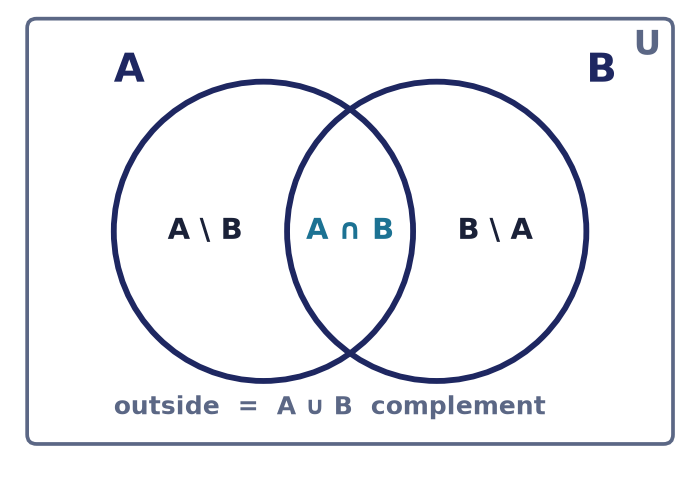
An Euler diagram is the same idea but shows only the relationships that actually occur — for example, if it draws circle inside circle with no spurious overlap. Venn diagrams fix the layout and shade; Euler diagrams tailor the layout to the situation.
How to shade an expression (work inside-out). To draw the region a formula denotes, evaluate it the way you would arithmetic — innermost operation first:
- shade each parenthesised sub-expression on a scratch copy;
- combine: union shades the union of the two regions; intersection keeps only the common part; difference keeps the part of outside ; complement shades everything outside the region.
For example, to shade : first shade (both of those circles), then keep only the part of that lies outside that shaded area.
How to read a formula off a diagram. Name the shaded region by the simplest combination of circles that produces it — e.g. “the parts of and but not ” reads as .
2.4 The algebra of sets
The operations obey algebraic laws. They let you simplify expressions and prove identities by symbol manipulation, without drawing.
| Law | Statement |
|---|---|
| Commutativity | |
| Associativity | , and likewise for |
| Distributivity | , and dually |
| Identity | |
| Domination | |
| Complement | |
| De Morgan | |
| Difference |
Note especially De Morgan (a complement of a union/intersection flips the operation and complements each part) and the difference law — these two do most of the work in the proof tasks.
2.5 Proving a set identity
To show two expressions denote the same set, use either method:
- Diagram / membership method. Shade the region for each side on its own Venn diagram. If the two shaded regions coincide, the identity holds. (Formally, this is checking that an arbitrary element lies in the left side exactly when it lies in the right side — a membership argument.)
- Algebraic method. Rewrite one side step by step using the laws of §2.4 until it becomes the other side, citing one law per step. Rewriting as is usually the first move, after which De Morgan and distributivity finish the job.
Both methods are legitimate; the diagram makes the result visible, the algebra makes it rigorous. Where practical, do both and check that they agree.
2.6 The power set
The power set is the set of all subsets of , including the empty set and itself. For example,
Each element of is independently in or out of a given subset, so an -element set has
subsets. To list a power set without omissions, enumerate subsets by size: first , then all singletons, then all pairs, and so on up to itself.
2.7 Working checklist
- Write sets in a consistent order (e.g. increasing) so equal sets are easy to compare, even though order does not matter formally.
- Before any complement, write down .
- For a diagram task, shade inside-out and label the final region.
- For a proof task, prefer converting to first, then apply De Morgan and distributivity.
- For a listing task, translate the set-builder condition into a test applied to each candidate, then collect those that pass.
2.8 Symmetric difference, Cartesian product, and inclusion–exclusion
Three further tools appear in the counting and product tasks.
- Symmetric difference : the elements in exactly one of and — the “exclusive or” of sets. Equivalently .
- Cartesian product : the set of all ordered pairs whose first component lies in and second in . Its size is .
- Inclusion–exclusion (two sets). : adding and counts the overlap twice, so it is subtracted once. For three sets, .