3. Classroom tasks and solutions / Аудиторні задачі та розв’язання
Source of tasks. The problems below are taken from the practical-class assignment for this topic (combinatorics and probability); only the wording has been translated to English. Every task is followed by a complete solution. Theory and notation are in 2method.md: the product rule, (arrangements), (combinations), (multisets), and the classical probability .
Combinatorics
Задача 1 — car plates
A car plate consists of four letters of an alphabet (12 letters are used) and four digits. How many different plates are there?
Each of the four letter positions is filled independently from letters, and each of the four digit positions from digits (–); repetition is allowed. By the product rule,
Задача 2 — captain and deputy
A football team has 11 players; a captain and a deputy captain must be chosen. In how many ways?
The two roles are distinct, so order matters, and one person cannot hold both, so there is no repetition — an arrangement of out of :
Задача 3 — a football-pools card
A card must predict the results of thirteen matches. Each result is a win for one of the two teams or a draw (three outcomes; the score does not matter). How many ways can one card be filled in?
Each of the matches has possible outcomes, chosen independently:
Задача 4 — balls into boxes
In how many ways can 4 black, 4 white, and 4 blue balls be placed into 6 different boxes?
Balls of the same colour are identical, so placing the balls of one colour into distinct boxes is a multiset (stars-and-bars) count — stars and bars:
The three colours are placed independently, so by the product rule
Задача 5 — a detachment from a company
A company has 3 officers, 6 sergeants, and 60 privates. In how many ways can a detachment of one officer, two sergeants, and twenty privates be formed?
Order within each rank does not matter, so each rank is a combination, and the three independent choices multiply:
With ,
Probability
Задача 6 — one ball from each of two boxes
Box 1 holds 2 white and 10 red balls; Box 2 holds 8 white and 4 red. One ball is drawn from each box. What is the probability that both are white?
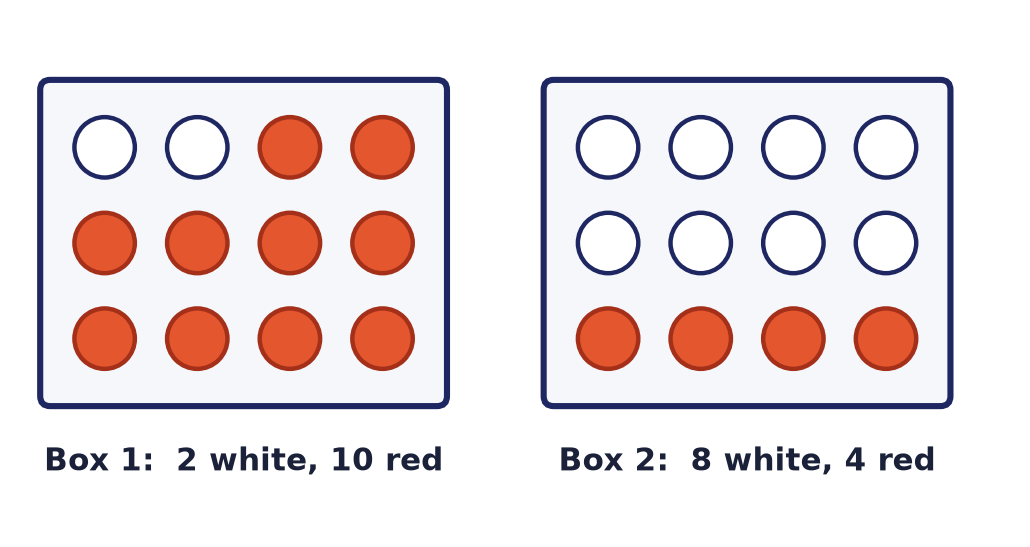
The two draws are independent (different boxes), so the probabilities multiply:
Задача 7 — two balls from one box
A box holds 10 white and 14 red balls (24 in all). Two balls are drawn. What is the probability that both are white?
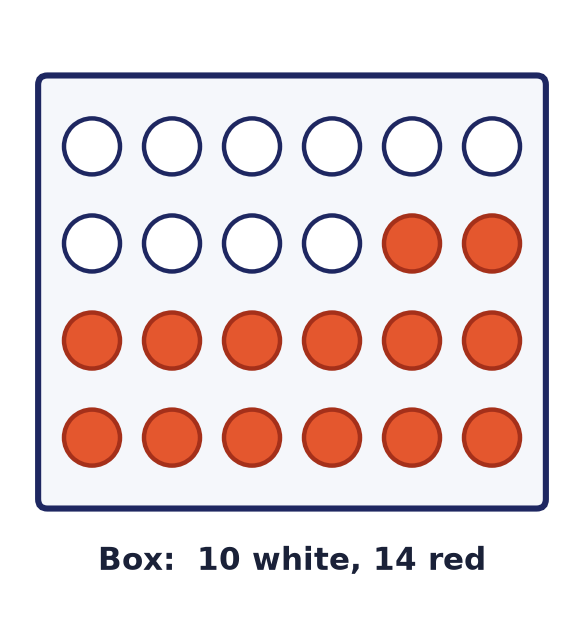
All two-ball subsets are equally likely, and of them are all-white:
Equivalently, drawing one after another, .
Задача 8 — grade of a part
A part is chosen at random. It is known that 4% of parts are defective, and that 75% of the non-defective parts are of the first grade. Find the probability that the part is of the first grade.
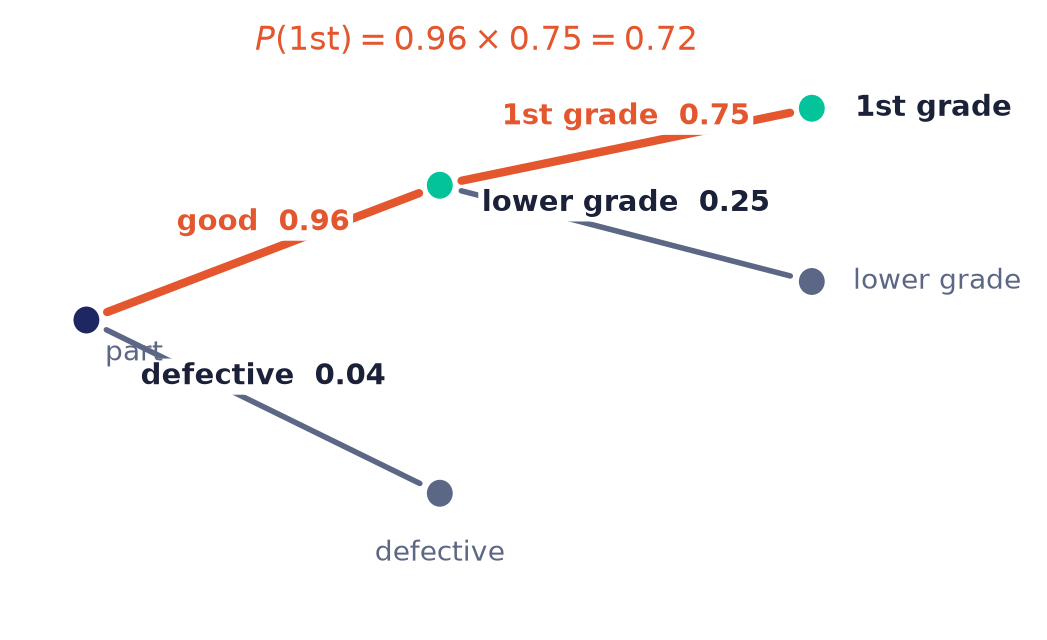
A first-grade part must first be non-defective — probability — and then first grade among the good ones — probability . Multiply along the branch (the conditional/multiplication rule):
Задача 9 — winning at least once
Of 100 lottery tickets, 5 are winning. Two tickets are bought. What is the probability of winning by at least one ticket?
Use the complement: “at least one win” is the opposite of “no win”. Both tickets missing means both come from the losing tickets:
As a check, counting the winning cases directly gives the same value: .