3. Classroom tasks and solutions / Аудиторні задачі та розв’язання
Source of tasks. The problems below are taken exactly from the practical-class assignment for this topic (relations and their properties); only the wording has been cleaned up and translated to English. Each task is followed by a complete worked solution. The theory used is in 2method.md; recall the core properties — reflexive ®, irreflexive (Ir), symmetric (S), antisymmetric (A), asymmetric (As), transitive (T) — and that a “no” is always justified by a witness pair.
Task 1 — Classify relations on
For each relation on the set , decide whether it is reflexive, irreflexive, symmetric, antisymmetric, asymmetric, and transitive.
Summary of verdicts (✓ = has the property, ✗ = does not):
| Relation | Refl. | Irrefl. | Sym. | Antisym. | Asym. | Trans. |
|---|---|---|---|---|---|---|
| (a) | ✗ | ✗ | ✗ | ✗ | ✗ | ✓ |
| (b) | ✓ | ✗ | ✓ | ✗ | ✗ | ✓ |
| (c) | ✗ | ✓ | ✓ | ✗ | ✗ | ✗ |
| (d) | ✗ | ✓ | ✗ | ✓ | ✓ | ✗ |
| (e) | ✓ | ✗ | ✓ | ✓ | ✗ | ✓ |
| (f) | ✗ | ✓ | ✗ | ✗ | ✗ | ✗ |
Justifications.
- (a) Not reflexive — missing . Not symmetric — has but not . Not antisymmetric — has both and . Transitive — every first coordinate is or , and are present for all the that occur, so each 2-step chain has its shortcut (e.g. ✓).
- (b) Reflexive — all of present. Symmetric — the only off-diagonal pairs are and , and both are present. Not antisymmetric — and with . Transitive — e.g. ✓, and all such shortcuts are present.
- (c) Not reflexive — no diagonal pairs. Symmetric — and both present. Not antisymmetric — same two pairs, . Not transitive — , which is missing.
- (d) Not reflexive — no diagonal pairs. Not symmetric — present but absent. Antisymmetric — no pair has its reverse, so the condition holds vacuously. Not transitive — is missing.
- (e) This is the identity relation. Reflexive, symmetric, antisymmetric, and transitive all hold — there are no off-diagonal pairs to violate anything. (It is both an equivalence relation and a partial order.)
- (f) Not reflexive — no diagonal pairs. Not symmetric — present, absent. Not antisymmetric — and with . Not transitive — is missing.
Irreflexive, asymmetric, antitransitive. Irreflexive is read straight off the diagonal (no self-loops): (c), (d), (f) qualify; the rest carry at least one loop. Asymmetric irreflexive antisymmetric, so only (d) is asymmetric — and it is moreover antitransitive, since its only 2-step chains and have no shortcut ().
Task 2 — Relations on the integers, defined by a rule
Determine whether the relation on the set of all integers is reflexive, irreflexive, symmetric, antisymmetric, asymmetric, and/or transitive, where if and only if:
Summary of verdicts:
| Rule for | Refl. | Irrefl. | Sym. | Antisym. | Asym. | Trans. |
|---|---|---|---|---|---|---|
| (a) | ✗ | ✓ | ✓ | ✗ | ✗ | ✗ |
| (b) | ✗ | ✗ | ✓ | ✗ | ✗ | ✓ |
| (c) or | ✗ | ✓ | ✓ | ✗ | ✗ | ✗ |
| (g) | ✗ | ✗ | ✗ | ✓ | ✗ | ✗ |
| (h) | ✗ | ✗ | ✗ | ✓ | ✗ | ✓ |
Justifications.
- (a) . Not reflexive: is false. Symmetric: gives . Not antisymmetric: and both hold with . Not transitive: and , but is false.
- (b) . Not reflexive: . Symmetric: . Not antisymmetric: and with . Transitive: forces to share a sign, so if also then share that sign and .
- (c) (i.e. ). Not reflexive: . Symmetric: . Not antisymmetric: and both satisfy it with . Not transitive: , but .
- (g) . Not reflexive: only for , not all . Not symmetric: since , but since . Antisymmetric: and force , so and then . Not transitive: and are in , but .
- (h) . Not reflexive: fails already at (). Not symmetric: () but (). Antisymmetric: and force , so and . Transitive: if and , then , so .
Task 3 — The inverse of a relation
Let be the “divides” relation on the set of positive integers. Find .
Solution. The inverse reverses every pair:
Renaming the dummy variables () states it in the usual order:
In words, is the “is a multiple of” relation: holds exactly when is a multiple of .
Task 4 — Operations on the relations and
Given and the two relations and on : represent each as a set of ordered pairs, and find their union, intersection, difference, and complement.
Solution. As sets of pairs (the universe is , with pairs):
- Union — every pair in or in ; this is exactly the relation :
- Intersection — no pair is both “less than” and “equal”:
- Difference — since the two relations are disjoint, removing changes nothing: (and symmetrically ).
- Complement (relative to ) — the pairs not in each relation:
Task 5 — A relation given by a matrix (doubles teams)
Given the set of table-tennis players , define the relation “to play in the same doubles team” by a matrix, and check its properties.
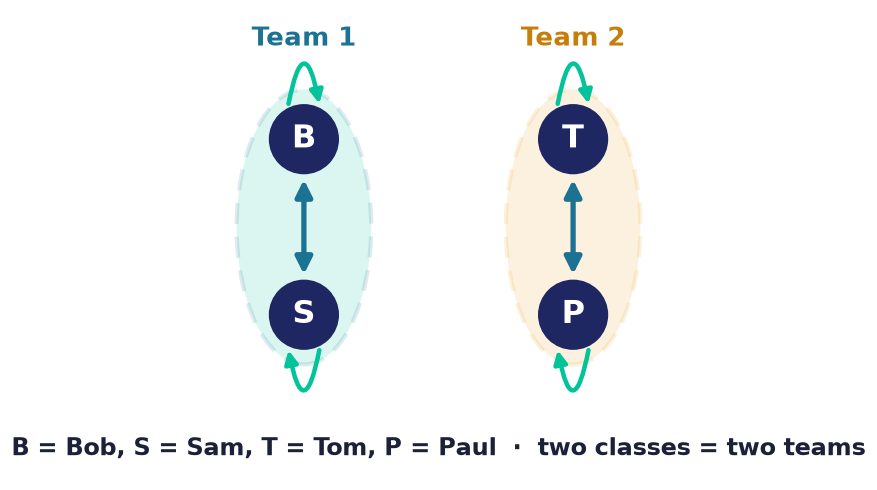
Solution. A doubles arrangement splits the four players into two teams of two; take Team 1 $= {}= {}$ (any pairing works the same way). “Same team” includes each player with themselves, so
As a Boolean matrix (order Bob, Sam, Tom, Paul):
| Bob | Sam | Tom | Paul | |
|---|---|---|---|---|
| Bob | 1 | 1 | 0 | 0 |
| Sam | 1 | 1 | 0 | 0 |
| Tom | 0 | 0 | 1 | 1 |
| Paul | 0 | 0 | 1 | 1 |
Properties. Reflexive — the diagonal is all (everyone is on their own team). Symmetric — the matrix equals its transpose (if is Sam’s teammate, Sam is ’s). Not antisymmetric — Bob and Sam are related both ways with . Transitive — the two blocks of $1$s are closed under chaining. Reflexive symmetric transitive means is an equivalence relation; its equivalence classes are the two teams ${}{}$ — a partition of .
Task 6 — One relation, three representations (divisibility)
Given and the relation meaning “ divides ” (, i.e. is a multiple of ), present as (1) ordered pairs, (2) a matrix, and (3) a directed graph, and determine its properties and type.
Solution.
(1) Ordered pairs. Test for all (note divides everything, and every number divides itself):
(2) Matrix ( iff ):
| 1 | 2 | 3 | 4 | |
|---|---|---|---|---|
| 1 | 1 | 1 | 1 | 1 |
| 2 | 0 | 1 | 0 | 1 |
| 3 | 0 | 0 | 1 | 0 |
| 4 | 0 | 0 | 0 | 1 |
(3) Directed graph. A self-loop at every node (since ), plus arrows , , and :
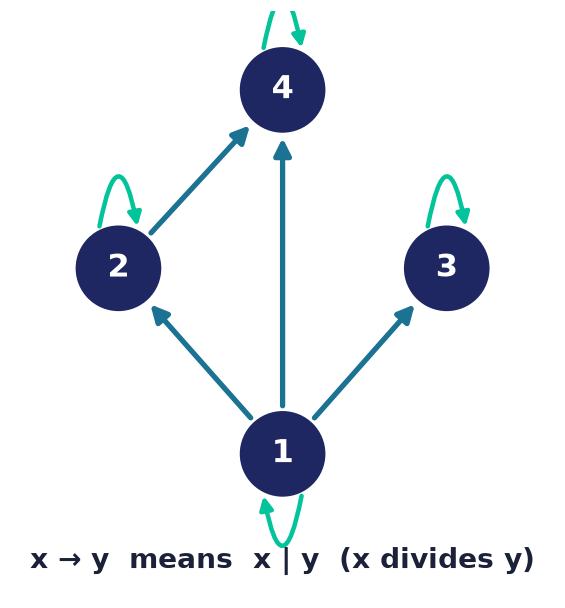
Properties and type. Reflexive — every is present (). Not symmetric — but ( but ). Antisymmetric — if and for positive integers then , so no two distinct elements are related both ways. Transitive — if and then (e.g. and give ✓). Being reflexive, antisymmetric, and transitive, is a partial order — the divisibility order on .