3. Classroom tasks and solutions / Аудиторні задачі та розв’язання
Source of tasks. The eleven problems below are taken exactly from the
practical-class assignment for this topic (set operations, Venn diagrams, and
set algebra); only the wording has been translated to English. Each task is
followed by a complete worked solution so the whole class can check every
step. The theory used is in 2method.md.
Throughout, A, B, C are sets inside a universe U; recall the difference
law A∖B=A∩B.
A. Illustrating operations with diagrams (Tasks 1–3)
Task 1
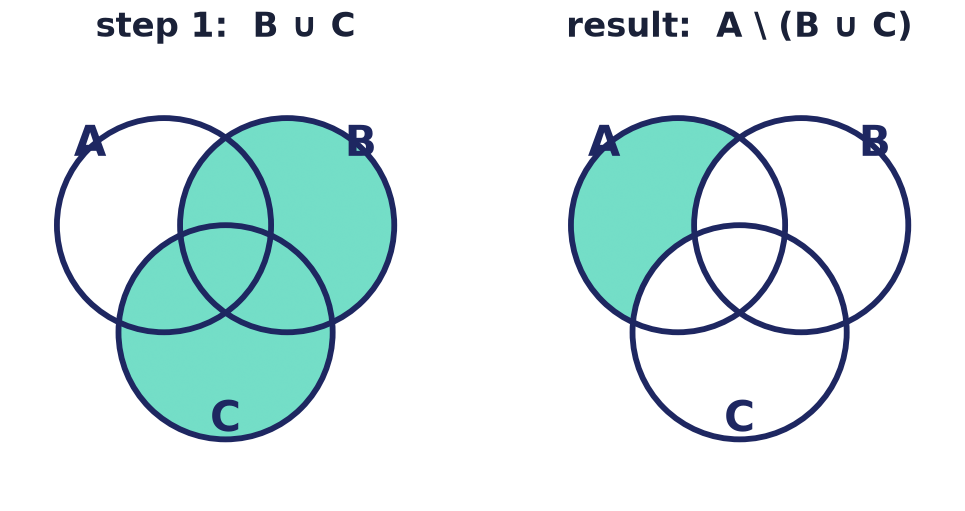
Illustrate the set E=A∖(B∪C) with Euler/Venn circles.
Solution. Draw three overlapping circles A, B, C inside the universe
rectangle. Shade inside-out:
- First mark B∪C — everything lying inside circle B or circle C.
- E=A∖(B∪C) keeps the part of A that is outside that
marked area.
So the answer is the “petal” of circle A that overlaps neither B nor
C — the portion of A separate from the other two circles. Everything of A
that it shares with B or with C is excluded.
Task 2
Using Venn diagrams, verify the identity
A∩(B∪C)=(A∩B)∪(A∩C).
Solution. Shade each side on its own diagram and compare.
- Left side A∩(B∪C). First shade B∪C (both circles B and
C); then intersect with A, keeping only the part of that region lying inside
A. The result is the portion of A that overlaps B or C.
- Right side (A∩B)∪(A∩C). Shade the lens A∩B and the
lens A∩C, then take their union. The result is again the portion of A
overlapping B, together with the portion of A overlapping C.
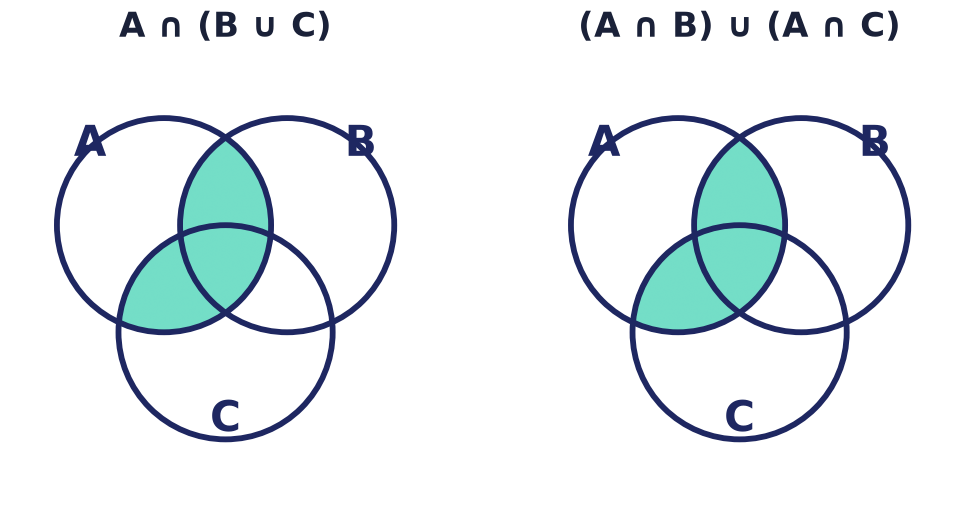
The two shaded regions coincide exactly, so the identity holds. (This is the
distributive law of ∩ over ∪.)
Task 3
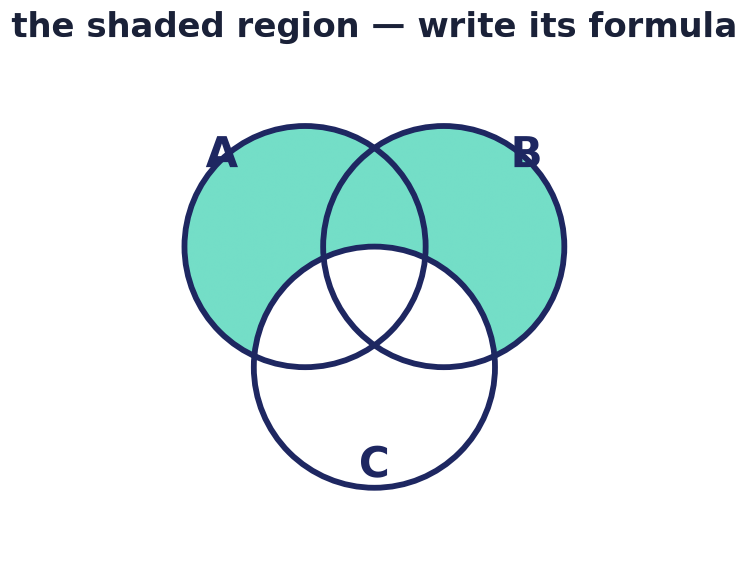
Write the formula for the shaded region of the given Venn diagram, where the
shading covers the parts of circles A and B that lie outside circle C.
Solution. Read the region inside-out:
- The shaded area covers everything in A or B — that is A∪B.
- …except whatever lies inside C, which is removed.
Removing C from A∪B gives
E=(A∪B)∖C.
B. Proving identities (Tasks 4–5)
Task 4
Prove that A∖(A∖B)=A∩B.
Solution (algebraic).
A∖(A∖B)=A∩(A∖B)=A∩(A∩B)=A∩(A∪B)=A∩(A∪B)=(A∩A)∪(A∩B)=∅∪(A∩B)=A∩B.(difference law)(A∖B=A∩B)(De Morgan)(double complement)(distributivity)(complement law)(identity law)
Hence A∖(A∖B)=A∩B. ■
Task 5
Prove that A=(A∩B)∪(A∖B), where A and B are sets.
Solution. Start from the right-hand side and use A∖B=A∩B:
(A∩B)∪(A∖B)=(A∩B)∪(A∩B)=A∩(B∪B)=A∩U=A.(difference law)(distributivity)(complement law, B∪B=U)(identity law)
Thus (A∩B)∪(A∖B)=A. Intuitively, every element of A
either is in B (so it lands in A∩B) or is not (so it lands in
A∖B); the two pieces together rebuild A. ■
C. Computing sets (Tasks 6–9)
For Tasks 6–9 let
A={2,4,6,8,10,12},B={3,6,9,12}.
Task 6
Write the set E=A∪B.
Solution. The union collects every element that is in A or in B
(each listed once):
E=A∪B={2,3,4,6,8,9,10,12}.
Task 7
Write the set E=A∩B.
Solution. The intersection keeps only the elements in both sets. Comparing
the lists, 6 and 12 occur in each:
E=A∩B={6,12}.
Task 8
Write the set E=A∖B.
Solution. The difference keeps the elements of A that are not in B.
Removing the shared elements 6 and 12 from A:
E=A∖B={2,4,8,10}.
Task 9
Write the set E=A∖B, the complement of A∖B
taken relative to the universe U=A∪B.
Solution. From Task 8, A∖B={2,4,8,10}, and from Task 6 the
universe is U=A∪B={2,3,4,6,8,9,10,12}. The complement removes
A∖B from U:
E=A∖B=U∖(A∖B)={3,6,9,12}.
(Notice this is exactly B — consistent with Task 5, since U=A∪B and
U∖(A∖B)=B here.)
D. Set-builder and power set (Tasks 10–11)
Task 10
List the elements of the following sets (with N={1,2,3,…}):
D={x∣x∈N and x is a divisor of 15},E={x∣x∈N and 15<x<30 and x is prime}.
Solution. Apply each defining property to the candidates.
- D: the natural-number divisors of 15 are 1,3,5,15 (since
15=1⋅15=3⋅5). Hence D={1,3,5,15}.
- E: test each integer strictly between 15 and 30 for primality. The
composites are ruled out (16,18,… even; 21=3⋅7; 25=52;
27=33), leaving the primes 17,19,23,29. Hence
E={17,19,23,29}.
Task 11
List the elements of the power set P(G), where G={1,2,3}
(P(G) is the set of all subsets of G).
Solution. Since ∣G∣=3, there are 23=8 subsets. Enumerate them by
size so none is missed:
- size 0: ∅;
- size 1: {1},{2},{3};
- size 2: {1,2},{1,3},{2,3};
- size 3: {1,2,3}.
Therefore
P(G)={∅, {1}, {2}, {3}, {1,2}, {1,3}, {2,3}, {1,2,3}}.
E. Counting and products (Tasks 12–13)
Task 12
In a group of 30 students, 18 study French and 15 study German, and 7 study
both. How many study (a) at least one of the two languages, (b) neither?
Solution. By inclusion–exclusion, ∣F∪G∣=∣F∣+∣G∣−∣F∩G∣=18+15−7=26. So (a) 26 study at least one language, and (b) 30−26=4 study
neither. The −∣F∩G∣ corrects the double-count of the 7 students who are inside
both ∣F∣ and ∣G∣.
Task 13
For A={1,2} and B={x,y,z}: (a) list A×B and give ∣A×B∣;
(b) compute the symmetric difference {1,2,3}△{2,3,4}.
Solution. (a) The Cartesian product pairs each element of A with each of B:
A×B={(1,x),(1,y),(1,z),(2,x),(2,y),(2,z)},∣A×B∣=∣A∣⋅∣B∣=2⋅3=6.
(b) The symmetric difference keeps the elements lying in exactly one set:
{1,2,3}△{2,3,4}={1,4} (the shared 2,3 drop out).
Practical/Practical1/3classroom.md · 7.6 KB · updated 2026-08-01 17:52