2. Methodical guidelines / Методичні вказівки
This section is self-contained: it collects all the theory needed for the theme — binary relations, their representations, properties, operations, and types — together with the techniques used to solve the tasks in 3classroom.md. No outside material is required.
2.1 What a relation is
A binary relation from a set to a set is any subset of the Cartesian product — that is, any set of ordered pairs with and . When we say “ is related to ” and write ; otherwise .
Most of this work concerns a relation on a set : a subset of . Because has pairs, there are different relations on . Two special relations recur:
- the identity (equality) relation — every element related only to itself;
- the empty relation and the universal relation .
2.2 Three ways to represent a relation
The same relation can be written in three interchangeable forms; a task may ask for any of them.
- Ordered pairs — list the members of , e.g. .
- Boolean matrix — an grid with exactly when , and otherwise. Rows are the “from” element, columns the “to” element.
- Directed graph (digraph) — draw a node for each element of and an arrow for each pair . A pair becomes a self-loop.
For example, on has the matrix and a digraph with a loop at and arrows , .
2.3 The core properties
Let be a relation on a set . The properties tested throughout this work are:
| Property | Definition | In the digraph | In the matrix |
|---|---|---|---|
| Reflexive | for every | a self-loop at every node | the whole diagonal is |
| Irreflexive | for every | no self-loops anywhere | the whole diagonal is |
| Symmetric | every arrow has a reverse | is symmetric () | |
| Antisymmetric | and | no two distinct nodes joined both ways | no with |
| Asymmetric | no reverse arrow and no self-loop | zero diagonal and no mirror pair | |
| Transitive | every 2-step path has a shortcut | the $1$s of the Boolean are already in | |
| Antitransitive | no 2-step path has a shortcut | wherever has a , has a |
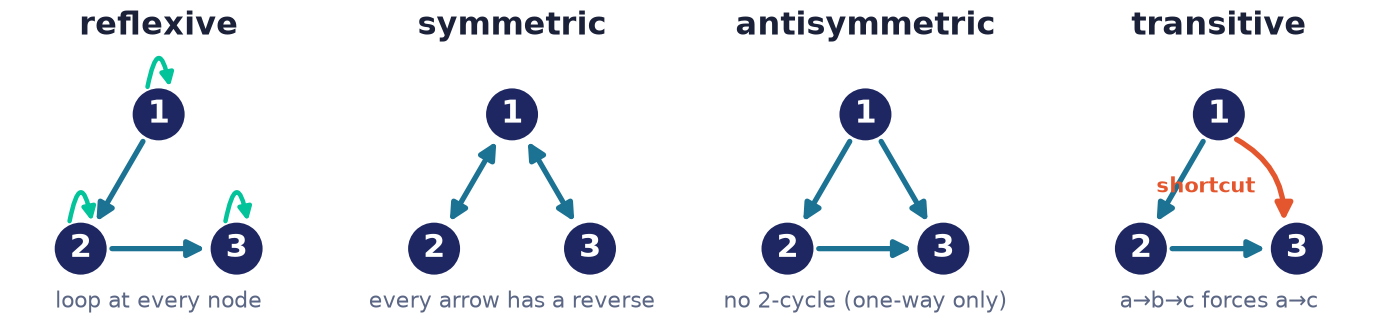
Three cautions that decide many exercises:
- Reflexive and irreflexive are not opposites. A relation can be neither — e.g. on has a loop at (so not irreflexive) but misses the loop at (so not reflexive).
- Antisymmetric is not “not symmetric.” They are different conditions. The identity relation is both symmetric and antisymmetric; many relations are neither. Antisymmetry only forbids a 2-cycle between distinct elements — self-loops never violate it. Asymmetric is the stronger cousin: asymmetric irreflexive antisymmetric (a strict order such as is the archetype).
- A “no” needs a witness. To disprove a property, exhibit one concrete offending pair (or missing pair): e.g. “not transitive because but .”
2.4 Operations on relations
Since relations are sets of pairs, the set operations apply directly. For relations and on :
| Operation | Definition |
|---|---|
| Union | |
| Intersection | |
| Difference | |
| Complement | |
| Inverse |
The complement is taken relative to the universe (all possible pairs), so always know how large is. The inverse simply reverses every pair (reverses every arrow in the digraph, transposes the matrix): if means “ divides ”, then means “ is a multiple of .”
(A related construction, used later, is composition — “follow , then .” It is not needed for this work.)
2.5 Types of relation
Certain combinations of properties have names and great importance:
- Equivalence relation — reflexive + symmetric + transitive. It models a notion of “sameness” and splits into disjoint equivalence classes (a partition): each element lies in exactly one class of things related to it. Examples: equality, “same remainder mod ”, “on the same team.”
- Partial order — reflexive + antisymmetric + transitive. It models a consistent “” in which some elements may be incomparable. Examples: on numbers, on sets, and divisibility on the positive integers.
Recognising a type is just checking the three defining properties and naming the result.
2.6 Working checklist
- To classify a relation, test the six properties one at a time; for each, either argue it holds for all required pairs, or give one counterexample.
- Watch the two traps: reflexive needs for every (a single missing loop kills it); antisymmetric is about distinct elements only.
- For a relation defined by a formula on the integers, test a property by reasoning about the formula (e.g. “, so the relation is symmetric”) and disprove it with a specific small pair.
- For an operation task, write both relations as pairs first, then combine; for a complement, remember the universe is .
- To find a type, check reflexive + (symmetric ⇒ equivalence) or (antisymmetric ⇒ partial order), together with transitive.